
 By
By 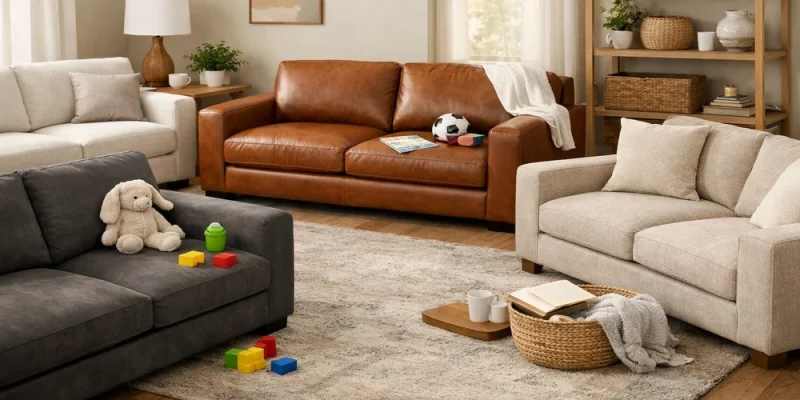
If you have young kids, you already know upholstery takes a beating in ways furniture marketing rarely accounts for: juice boxes with imperfect lids, marker caps that mysteriously disappear, popsicles that never quite make it to a napkin. The good news is that fabric technology has come a long way, and there are genuinely durable, stain-resistant upholstery options that can handle real family life without sacrificing comfort or style. Here’s what to actually look for.
Performance Fabrics: The Category Worth Knowing
“Performance fabric” has become the industry’s catch-all term for upholstery engineered specifically to resist stains, moisture, and everyday wear far better than traditional fabric options. These fabrics are typically made from tightly woven synthetic fibers, sometimes treated with additional stain-resistant coatings, and are designed to let most spills wipe away cleanly rather than soaking in. For families with young kids, upholstery labeled as a performance fabric is generally worth prioritizing over traditional natural-fiber options, even if it costs slightly more upfront.
Faux Leather: The Wipeable Workhorse
Faux leather (sometimes called vegan leather or leatherette) remains one of the most practical upholstery choices for families with young kids simply because most spills can be wiped away with a damp cloth in seconds, without any soaking-in period at all. It resists staining far better than almost any fabric option, and modern faux leather has improved significantly in look and feel compared to the stiffer, less breathable versions common years ago. The tradeoff is that faux leather can feel warmer or less breathable in some climates, and lower-quality versions may crack or peel over time – a good reason to prioritize reputable brands and construction quality over price alone.
Genuine Leather: More Durable Than People Expect
Genuine leather often gets a reputation for being high-maintenance, but with proper (and fairly minimal) care, it’s actually one of the more forgiving materials for families. Leather resists staining reasonably well on its own and, unlike many fabrics, tends to look better with age rather than visibly wearing out, developing a natural patina over years of use. It’s a stronger investment for families planning to keep furniture long-term, though it typically comes at a higher price point than performance fabric alternatives.
What to Avoid With Young Kids in the House
A few upholstery choices consistently cause more headaches for families with young children:
- Light-colored, untreated natural fibers like raw cotton or linen, which stain easily and are difficult to fully clean once a spill sets in.
- Silk and silk blends, which are delicate, prone to water spotting, and generally unsuited to households with unpredictable spill risk.
- Loosely woven or textured fabrics, which tend to trap crumbs, hair, and debris in ways that are hard to fully clean even with regular vacuuming.
Color and Pattern Strategy Matters Too
Material is only part of the equation – color and pattern choices can meaningfully reduce how noticeable everyday messes actually are. Medium tones and subtle patterns tend to hide stains, crumbs, and general wear far better than either very light or very dark solid colors, both of which tend to show marks, dust, or fading more visibly over time. A busy micro-pattern or tweed-style weave can be a particularly practical choice for family sofas and chairs, since it visually breaks up minor stains and everyday wear better than a smooth solid color would.
Cleaning Codes Are Worth Checking Before You Buy
Most upholstered furniture includes a cleaning code (W, S, WS, or X) indicating what cleaning methods are safe for that specific fabric. “W” fabrics can typically be cleaned with water-based solutions, making them considerably easier to manage around kids, while “S” fabrics require solvent-based cleaning only, which is less convenient for regular family use. Checking this code before buying – rather than after the first spill – can save a lot of frustration down the line.
Real Feedback From Other Families
Fabric performance claims can be hard to judge from a product listing alone, especially for families trying to gauge how a specific piece will actually hold up day to day. Looking through Coleman furniture reviews can offer a clearer, more grounded sense of how specific upholstered pieces have performed for other households with young kids, beyond what a spec sheet alone can tell you.
Maintenance Still Matters, Even With Durable Fabric
Even the most stain-resistant upholstery benefits from quick action when spills happen – blotting rather than rubbing, and addressing stains before they have time to set, makes a meaningful difference regardless of how resistant the fabric is. General upholstery cleaning and stain-removal guidance from independent home-care resources is worth keeping bookmarked for the inevitable day a marker cap goes missing.
Durable Doesn’t Have to Mean Dull
The biggest shift in family-friendly upholstery over the past several years is that “durable” no longer means limited to a handful of drab, purely practical options. Performance fabrics, quality faux leather, and even genuine leather now come in styles that hold their own aesthetically, meaning families no longer have to choose between furniture that looks good and furniture that can actually survive daily life with young kids. With the right material and a little strategy around color and pattern, it’s entirely possible to have both.












Comments