
 By
By 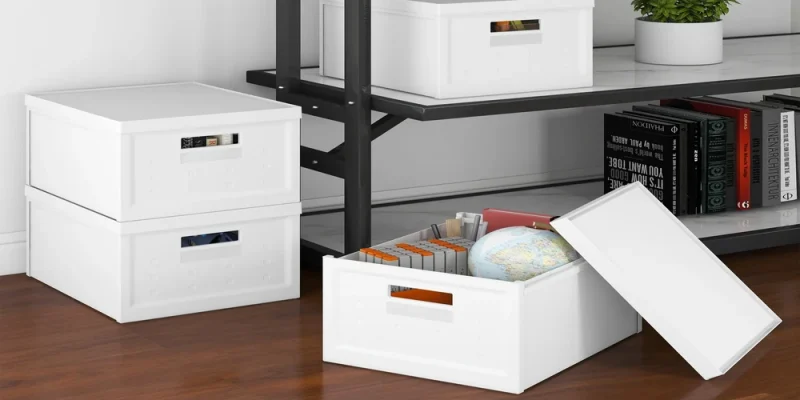
A storage box with a lid is one of those purchases that seems straightforward until you are standing in front of a wall of options and realise how many ways they can differ from one another. Size, material, lid mechanism, stackability, load rating, and intended use environment all vary considerably, and choosing the wrong box for a given application means either a box that fails under use conditions or one that wastes space and budget for unnecessary over-specification.
Why the Lid Matters as Much as the Box
The lid is not an optional accessory. It determines the storage box’s usefulness in several ways that are not immediately obvious from looking at the container alone.
A loose-fitting lid that rests on top of the box provides minimal protection from dust and moisture but collapses under any stack load. A snap-fit lid that secures at multiple points provides better protection and can typically support stacking, though the security of the snap mechanism degrades with repeated opening and closing cycles over time. A hinged lid integrated with the box provides convenience for frequently accessed items but typically cannot support the same stack loads as a separate lid that covers the full top surface of the container.
For warehouse and industrial applications, the lid’s contribution to structural rigidity is significant. A closed storage box with a well-designed lid can typically support two to three times the stack load of the same box open or with a loose-resting lid, because the lid braces the top of the box walls and distributes the load more evenly to the base.
Material Considerations
Storage boxes with lids in industrial and commercial applications are predominantly produced in HDPE (high-density polyethylene) or PP (polypropylene). Both materials are food-safe, chemically resistant, impact-resistant, and stable across the temperature range encountered in Singapore’s ambient storage environments.
HDPE is more impact-resistant at low temperatures and resists many chemicals that attack other plastics. PP is lighter for a given wall thickness, has better fatigue resistance in hinge and snap applications, and can be produced in a wider range of colours without pigment issues.
For home and light commercial applications, PET or clear PP containers with lids are popular because they combine structural adequacy with the visual clarity that allows quick identification of contents without opening the container.
Sizing for Space Efficiency
Space efficiency in storage is achieved through discipline in sizing. A mixed collection of boxes in varying dimensions creates gaps and wasted vertical space that a standardised system avoids. Choosing storage boxes in a modular size relationship, where smaller boxes nest or stack within the footprint of larger ones, maximises the use of available shelf or floor space.
As Singapore’s Housing Development Board notes in its guidance on space optimisation for HDB flats, “Standardised storage systems that stack and interlock make the most efficient use of limited vertical space.” The principle applies equally to industrial warehouses and residential storage rooms. A space-saving storage box system built around a modular footprint delivers measurably better space utilisation than an ad hoc collection of different-sized containers.
Labelling and Identification
Effective organised storage requires identification of contents without opening every box. The approaches available depend on the box material and the frequency with which contents change.
- Permanent adhesive labels on the exterior of the lid or the front face of the box work well for contents that do not change. Ensure the label surface is clean and dry before applying and that the label material is rated for the storage environment temperature.
- Label holders or pockets attached to the box exterior allow label cards to be inserted and changed easily, which suits applications where box contents are reassigned regularly.
- Clear or semi-transparent lids allow visual identification of contents directly, eliminating the need for labelling when contents are visually distinctive.
- Colour coding of the boxes themselves, using different lid or body colours for different content categories, provides immediate visual organisation without requiring individual labels.
Heavy Duty vs. Standard Applications
Industrial storage boxes with lids used for heavy components, tools, or dense materials require specification attention that light-use home storage containers do not. Wall thickness, base reinforcement, and lid load rating all need to be matched to the actual weight of contents and the number of stack levels expected. A box designed for light domestic use and stacked five high in a warehouse with dense contents will fail through deformation or fracture, creating safety and product damage risks.
For any application where contents are heavy or where stack heights exceed two to three boxes, selecting containers with confirmed load ratings relevant to your actual application is important.
A Practical Investment in Organisation
The right storage box with lid for your application is one specified for the actual content weight, storage environment, access frequency, and space constraints of your situation. Match the specification to the use, build around a standardised size system, label clearly, and the investment in proper storage boxes pays back quickly in reduced time spent locating items and better use of available space.











Comments