
 By
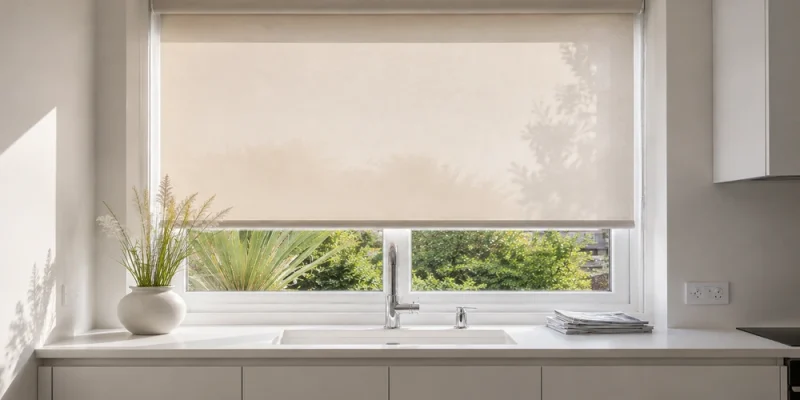
Roller blinds look simple, but the fabric choice decides almost everything: how much light gets in, how much heat you block, and whether your neighbours can see in at night. The number most people skip over on the sample card, the openness factor, is the one that matters most.
This guide walks through it room by room. It draws on how Sydney installers such as Roma Blinds match fabrics to rooms when they measure up. If you’re still deciding between blind types, this comparison of roller vs Roman vs venetian blinds is a good place to start.
Sunscreen or blockout: the first decision
There are two main families of roller blind fabric.
- Sunscreen is a woven mesh. It cuts glare and heat but keeps your view out during the day.
- Blockout is a solid, coated fabric. It stops light coming through the fabric itself, which is what you want for sleep.
Most homes end up with both: sunscreen in living areas, blockout in bedrooms.
What the openness factor means
Sunscreen fabrics are sold by openness: the percentage of the weave that’s open. A lower number means a tighter weave.
| Openness | View out | Glare and heat | Best for |
|---|---|---|---|
| 1% | Soft, muted | Blocks the most | West-facing rooms, home offices, TV areas |
| 3% | Clear | Strong control | North or west living areas |
| 5% | Clearest | Good control | Most living rooms and kitchens |
| 10% | Very clear | Light control only | Shaded windows, under deep eaves |
As a rule of thumb, 5% suits most Australian living rooms. Drop to 3% or 1% where afternoon glare on screens is the problem.
The night-time catch
This is the part many people find out too late. Sunscreen works by being brighter on one side. During the day the outside is brighter, so you can see out but people can’t easily see in. At night, with your lights on, that flips. Anyone outside can see straight through a sunscreen blind.
If a street-facing room needs night privacy, you have two options. Choose a blockout fabric, or fit a dual roller: a sunscreen and a blockout on one bracket, so you can use whichever suits the time of day.
Room by room
- Bedrooms and nurseries: blockout. Fit it outside the recess, or ask about side channels, to cut the light that leaks around the edges.
- Living rooms: 5% sunscreen for daytime, or a dual roller if the room faces the street.
- Home office: 1% or 3% sunscreen to stop glare on your screen without losing daylight.
- Kitchens and bathrooms: a moisture-resistant PVC-coated fabric that wipes clean.
Don’t forget insulation
YourHome, the Australian Government’s guide to sustainable homes, estimates up to 40% of a home’s heating energy can be lost through windows in winter. A well-fitted blockout roller won’t match double glazing, but closing it at night does help hold warmth in.
Measuring and fitting
Inside the recess gives a neat, built-in look. Outside the recess covers the frame and blocks more light at the sides. For wide windows, two or three blinds side by side are easier to use than one heavy one. On tall or hard-to-reach windows, motorisation is worth the extra cost.
Made-to-measure blinds avoid the gaps you get with off-the-shelf sizes. Most local suppliers offer a free measure and quote, which takes the guesswork out of sizing.
The bottom line
Pick blockout for sleep and sunscreen for daylight. Choose 5% for most living spaces and 1% to 3% for glare-heavy rooms, and plan for night-time privacy before you order. Get those choices right and a roller blind will do its job quietly for years.






Comments