
 By
By 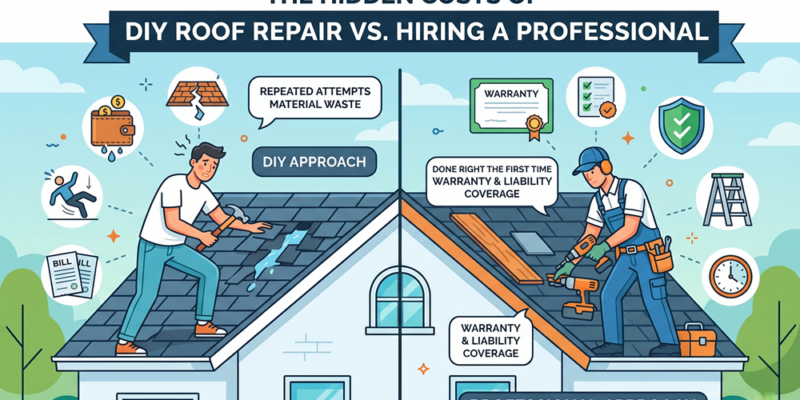
On the surface, DIY roof repair looks like an obvious money-saver. Materials are available at any home improvement store, video tutorials make the process look manageable, and skipping labour costs seems like straightforward financial logic. For a minor, clearly defined repair on a low-slope roof performed by someone with genuine construction experience, that logic sometimes holds up. For most homeowners, the full cost accounting looks quite different once you include everything a YouTube tutorial does not mention.
This article is not an argument against homeowners maintaining their properties. It is an honest look at the costs that rarely appear in the initial comparison, so you can make a decision with an accurate picture of what each path actually involves.
Material Costs Are Not What You Think
Roofing materials are sold at retail for the DIY market, and the prices reflect that. A roofing contractor purchasing the same materials works with supplier accounts, volume pricing, and trade relationships that are not available at the consumer level. The material cost differential between a homeowner buying shingles at a big-box store and a contractor buying from a roofing supplier can range from 15 to 30 percent on the same product. That gap alone narrows the apparent savings before a single tool is picked up.
There is also the problem of material mismatch. Matching existing shingles precisely requires knowing the manufacturer, the product line, the colour batch, and the installation date. A contractor like LEN Roofing has direct access to supplier networks and can source matching materials accurately, which protects both the aesthetic result and the manufacturer warranty on existing materials.
The Tools You Do Not Already Own
A proper roof repair requires more than a hammer and a caulk gun. Roofing nail guns, safety harnesses, stabiliser ladders, ridge caps, appropriate underlayment, drip edge material, and flashing tools are not items most homeowners have on hand. Renting or purchasing these for a single repair project adds meaningfully to the actual cost and introduces the risk of using unfamiliar equipment on a sloped surface at height.
Falls from roofs are one of the most common causes of serious home improvement injuries. Professional roofers work with fall protection equipment and training refined specifically for working on pitched surfaces. That is not a reason to avoid all rooftop maintenance, but it is a legitimate cost that belongs in the comparison, particularly for steeper roofs or homes with difficult access.
Warranty and Insurance Implications
Most manufacturer warranties on roofing materials include installation requirements. Products must be installed by a licensed contractor using approved methods for the warranty to remain valid. DIY installation, or installation by an unlicensed individual, typically voids the product warranty entirely. If the repair fails and the underlying issue causes water damage, you are managing that claim without warranty support.
Homeowner’s insurance policies also contain language about workmanship. If a self-performed repair is later found to have contributed to subsequent damage, the insurer may decline to cover that damage on the basis that it resulted from improper repair rather than a covered event. That risk does not appear in the upfront cost comparison but can be substantially larger than the original repair cost.
The Cost of Getting the Diagnosis Wrong
The most significant hidden cost in DIY roof repair is not the repair itself. It is the cost of misdiagnosis. A homeowner who patches a visible area of missing shingles and believes the problem is solved may not recognise that the source of the leak is actually at the flashing around a penetration six feet away. The visible symptom was the shingle. The actual entry point for water was the flashing seal that has been failing for two seasons. That misdiagnosis means the leak continues, the water damage progresses, and the eventual professional repair is now a larger scope job than it would have been if a trained eye had assessed the full roof at the outset.
When the Math Actually Works Out
The total cost of professional repair, once materials, labour, warranty protection, and liability are factored in together, is frequently closer to the true DIY cost than it appears at first glance. And for any repair involving the roof deck, flashing, valleys, or penetrations, the diagnostic and technical complexity strongly favours professional work.
For Chicago-area homeowners weighing this decision, a free evaluation from an experienced contractor gives you an accurate scope and cost before committing to anything. Reviewing what is covered under professional roofing services is a practical first step that gives you a realistic basis for deciding which path makes financial and practical sense for your specific roof.












Comments